
BLOG
Forward head posture angle: what the CVA measures and why app angles differ
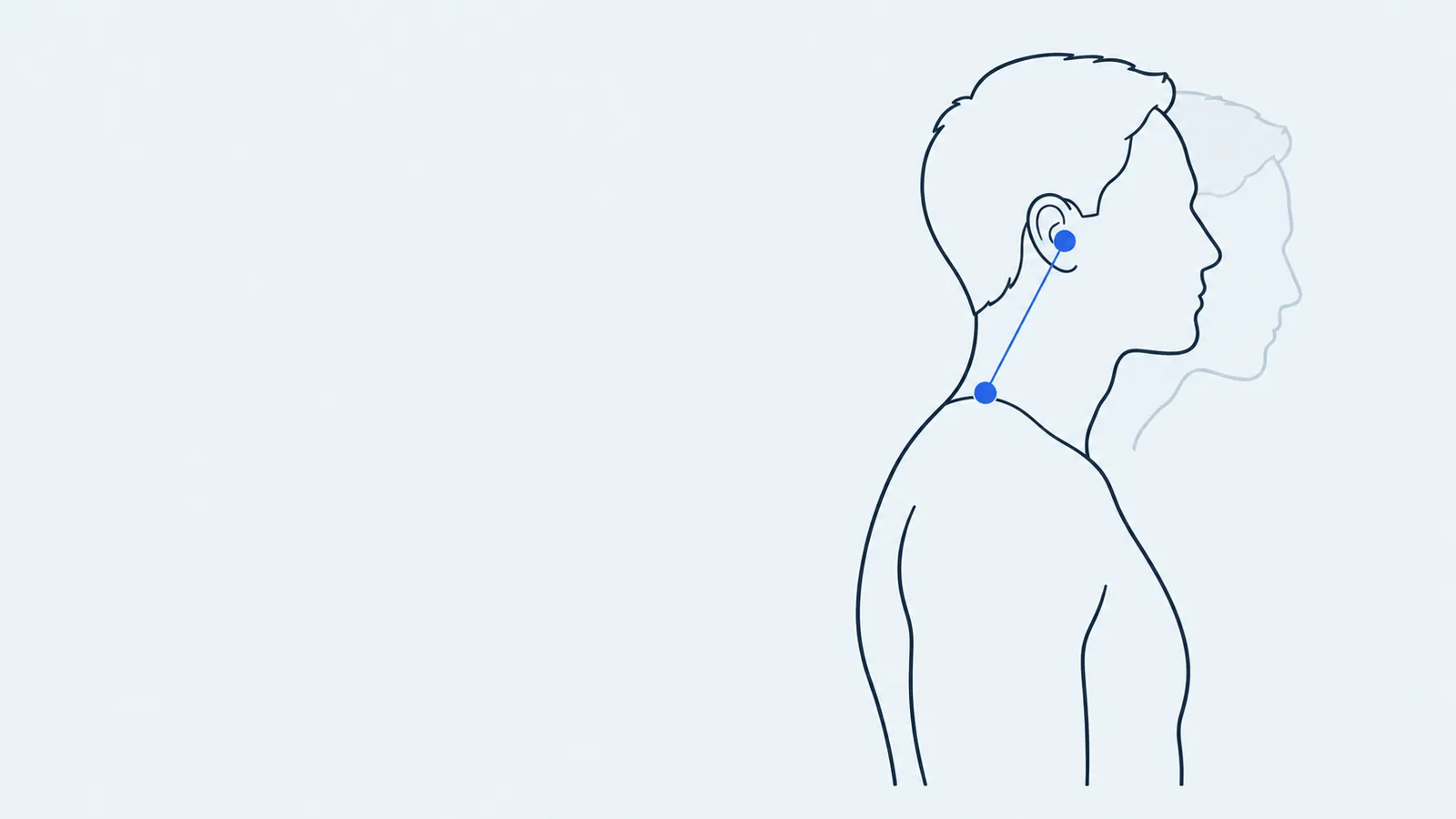
A forward head posture angle measures how far the head sits in front of the body in a side view. Research usually uses the craniovertebral angle (CVA): the angle at the C7 vertebra between the horizontal and a line to the ear, where lower means a more forward head, and studies agree on no single cutoff. Phone apps, PoseAlign included, compute their own angle from detected body points, so read their number on its own scale, not against CVA studies.
How the craniovertebral angle is measured
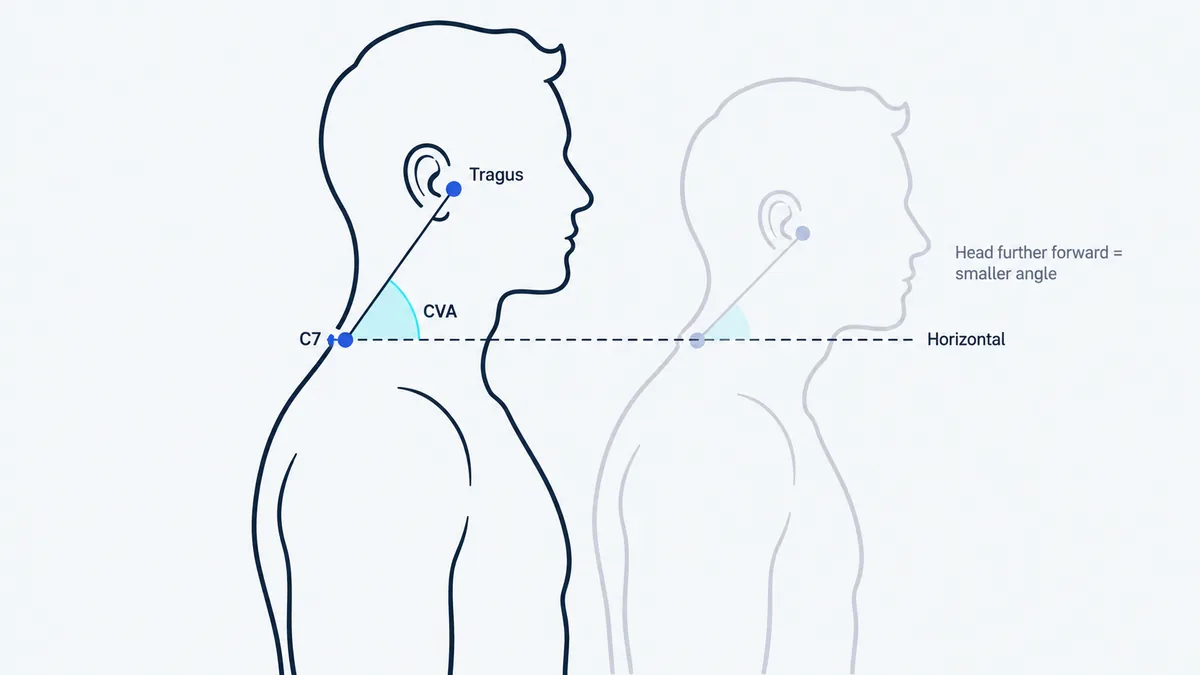
The craniovertebral angle is drawn on a side photo between two lines: a horizontal line through the spinous process of C7 (the bony bump at the base of the neck) and a line from C7 to the tragus, the small flap in front of the ear canal. When the head moves forward, the ear moves further in front of C7 and the angle gets smaller. A 2024 study by Titcomb et al. describes the CVA as the most recognised clinical standard for side-view head and neck posture, with X-rays as the gold standard. A 2017 review lists several other names for it in the literature, including cervical angle, neck inclination angle, head protrusion angle and forward head position.
In studies, the setup is tightly controlled. An examiner finds C7 and the tragus by touch and puts markers on them. In a 2025 reliability study by Mylonas et al., an iPhone on a tripod stood 1.4 m from each of 30 university students at a height of 1.8 m, level with the shoulders, and the angle was measured afterwards in ImageJ software. Mylonas et al. reported intraclass correlation coefficients for the CVA of 0.98 between four physical therapists on the same day and 0.95 when one therapist measured again the next day. The coefficient runs from 0 to 1, where 1 means perfect agreement. The authors note that a group of healthy students may not represent older people or patients.
What does a normal neck look like from the side?
There is no agreed normal number. Studies of mostly young adults report standing or relaxed CVA averages around 50°, with wide spread between people. These are group averages from specific samples, not targets:
| Study | Who was measured | Average CVA (± standard deviation) |
|---|---|---|
| Titcomb et al., 2024 | 98 young adults without pathology, mean age about 20 | Standing 50.0° ± 5.2°; sitting 47.8° ± 5.7° |
| Cote et al., 2021 | 66 physical therapists and physical therapy students, photographed over a video call | Relaxed 50.7° ± 6.3°; "best posture" 55.5° ± 5.4° |
| Rani et al., 2023 (meta-analysis) | 12 photo-based studies, 850 people aged 10 and over, with and without neck pain | Neck pain groups averaged 2.93° lower than pain-free groups |
The table shows how much the number depends on the moment. In Titcomb et al., sitting lowered the average by about 2°, and the gap was larger in people with a more forward head; the authors suggest standing as the standard position. In Cote et al., asking people to stand in their "best posture" raised it by about 5°.
The link with neck pain is a small average difference between groups, not a rule for individuals. In the Rani meta-analysis, neck pain groups averaged 2.93° lower, but the 12 studies varied widely. A 2019 meta-analysis of 15 studies by Mahmoud et al. found a more forward head in adults with neck pain than in adults without, but no difference in adolescents. All of the studies in that review were cross-sectional, measuring posture and pain at the same time, so they cannot show whether head position leads to pain or pain changes head position. In the small Cote sample, the 11 people with symptoms had the same average CVA (50.5°) as those without.
Pages that rank for this topic often call a CVA below 50° forward head posture. Titcomb et al. found cutoffs from 44° or less to 54° or less in the literature and note that their validity is debated, so this article gives no threshold.
What a side photo can and cannot show
A well-taken side photo shows where your ear sits relative to your shoulder and trunk at one moment. It can also show whether your head is tipped up, down or turned, and, if you photograph each, how your head position differs between standing, sitting and using a phone.
How closely the photo angle reflects the neck underneath is less settled. A 2017 review of 21 studies by Singla et al. reports that the CVA has been compared with similar angles on X-rays; in one of those studies, of 80 women aged 19 to 35, the two angles correlated only moderately (r = 0.68). A 2022 systematic review of non-radiographic methods was more cautious: skin landmarks for the ear and C7 cannot be as accurate as points located on an X-ray, and for validity "the evidence is not conclusive". In a 2024 study by Oakley et al. of 120 adults with chronic myofascial pain, the photo CVA correlated only weakly with an X-ray measure of forward head position (r = 0.549), and the authors concluded the CVA cannot replace X-ray measures of the neck's curve.
The same 2022 review found the strongest evidence for reliability in marker-based photo measurement. So a photo angle is well supported for repeating one measurement under one setup, and poorly supported for conclusions about the spine. A side photo cannot show:
- The cervical spine. The CVA is one line from the ear to the base of the neck. It says nothing about the curve of the neck or individual vertebrae.
- The cause. A photo cannot tell you why your head sits where it does, how your neck moves, or whether your posture relates to any pain.
- Your posture across the day. One standing photo does not show how you sit at a desk or look at a phone.
For more on these limits, see how accurate photo posture analysis is.
Why a phone app cannot reproduce the CVA
A phone app replaces the examiner's markers with points found by a pose estimation model, then measures an angle between lines through those points, or between one line and the image's horizontal or vertical. Google's MediaPipe Pose Landmarker, a widely documented public model, tracks 33 body points, including each ear and shoulder. Its list has no point for C7. An app using a model like this has no C7 to start from, so it has to define its own angle from the points it has.
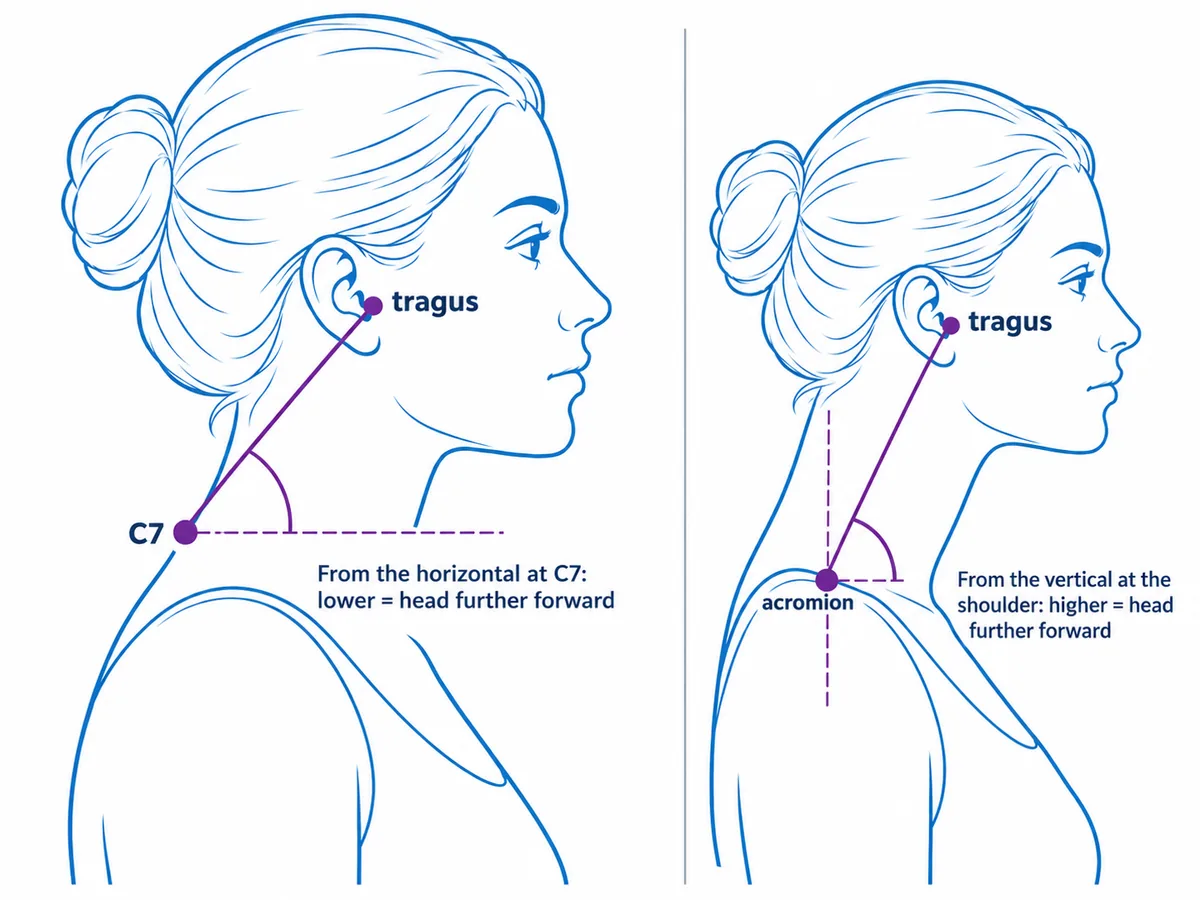
The name "forward head angle" does not tell you which angle that is, because head-position angles in research run in opposite directions. In the CVA, measured from the horizontal at C7, a lower value means a more forward head. A 2024 study of 145 adolescents used a depth-sensor system to measure a forward neck tilt angle between a vertical line and the line from the shoulder to the ear; by that definition, a higher value means the ear sits further in front of the shoulder. In a photo app, the horizontal or vertical reference comes from the image, so a tilted phone tilts the reference line and every angle measured against it.
How to read PoseAlign's forward head angle
PoseAlign shows its forward head angle in degrees in the side-view table of the report, above pelvic tilt from the same side photo. In the latest example on the site, the forward head angle is 12.3° and pelvic tilt is 1.6°.
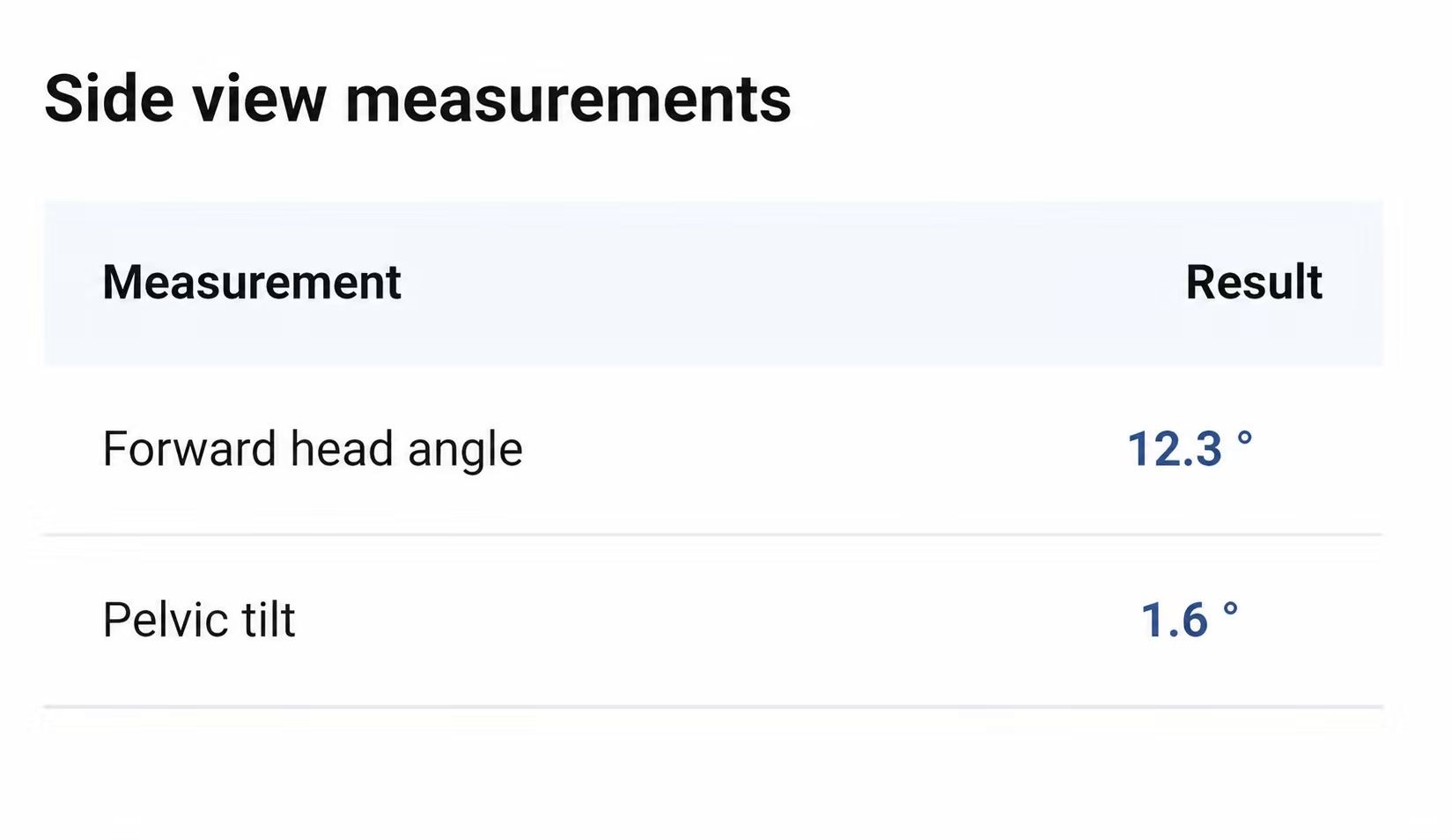
PoseAlign does not publish the formula behind this value, which points and reference line it uses, or the rule that highlights a row. An earlier PDF export dated September 15, 2026, on the posture report page, shows 24° in the same row, highlighted in red, while the latest 12.3° is not highlighted. Our reading, which PoseAlign has not confirmed: this pattern is consistent with a deviation angle in which a larger number means the head sits further forward of the shoulders.
Our reading is also that 12.3° is not a CVA value. In Titcomb et al., the 98 young adults averaged 50.0° standing, and even the 15 selected for a CVA below 45° averaged 41.2°. CVA averages and cutoffs from studies do not apply to PoseAlign's number, and the example values are not targets or a definition of normal posture.
Use the number to compare your own reports taken the same way, and allow for measurement error. With skin markers and trained examiners, a smartphone CVA app studied by Gallego-Izquierdo et al. (2020) in 44 adults (mean age 23) had a minimum detectable change of 4.96° for the same examiner and 5.52° between examiners. Those figures apply to that study's CVA method, not to PoseAlign. If a PoseAlign report changes from 14° to 12°, its unpublished measurement error means we cannot tell from that 2° difference whether your posture changed. Repeating the photos can reveal variability, but does not establish a validated change threshold.
The report draws the detected points on your side photo. Check that the ear and shoulder points sit on your ear and shoulder before you read the number; long hair, a hood or a high collar can move them. The side-view analysis page shows the example, and the guide to reading a posture analysis report covers the other values. PoseAlign is not a medical device and does not diagnose any condition.
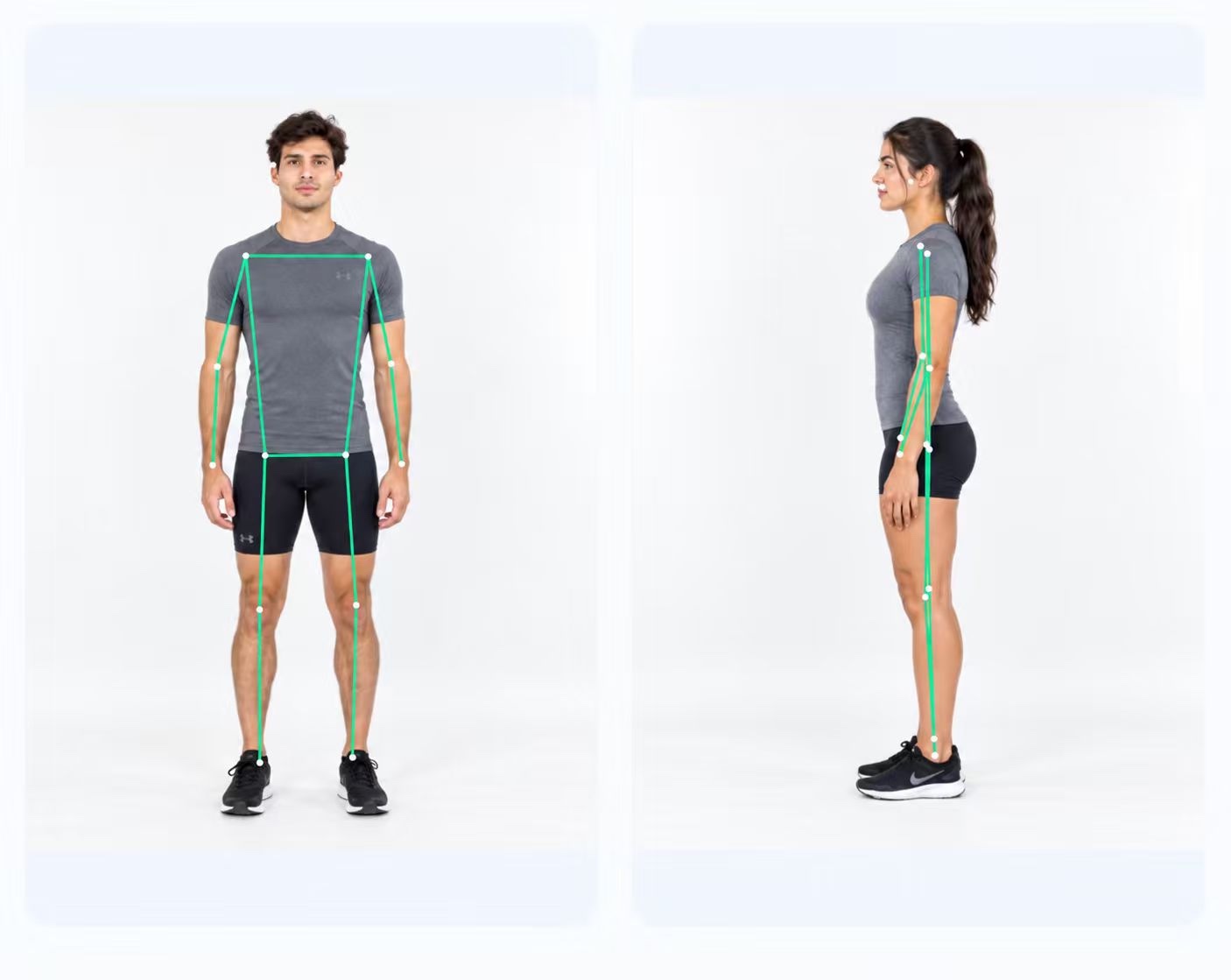
Getting a side photo you can compare
The study protocols above translate into a routine you can repeat at home:
- Tie long hair back and wear a top that leaves your ear and neck visible.
- Put the phone on a stand or shelf, level, at the same height and distance each time. For a full-body photo, the posture photo guide suggests waist to chest height.
- Stand fully side-on, head to feet in the frame, and use the same side each time.
- March on the spot five times, nod your head down and up three times, then look straight ahead at the wall, not at the phone. This follows the Titcomb et al. routine.
- Stand in your usual relaxed posture, without pulling yourself up, and hold still for about five seconds while the self-timer runs.
- Take two photos and check that the value is stable before you rely on it.
If your neck hurts, a photo is not the right tool. The NHS advises seeing a GP if neck pain or stiffness does not go away after a few weeks, if painkillers have not worked, or if you also have pins and needles or a cold arm.