
BLOG
Head tilt posture in a front photo: is it you or the camera?
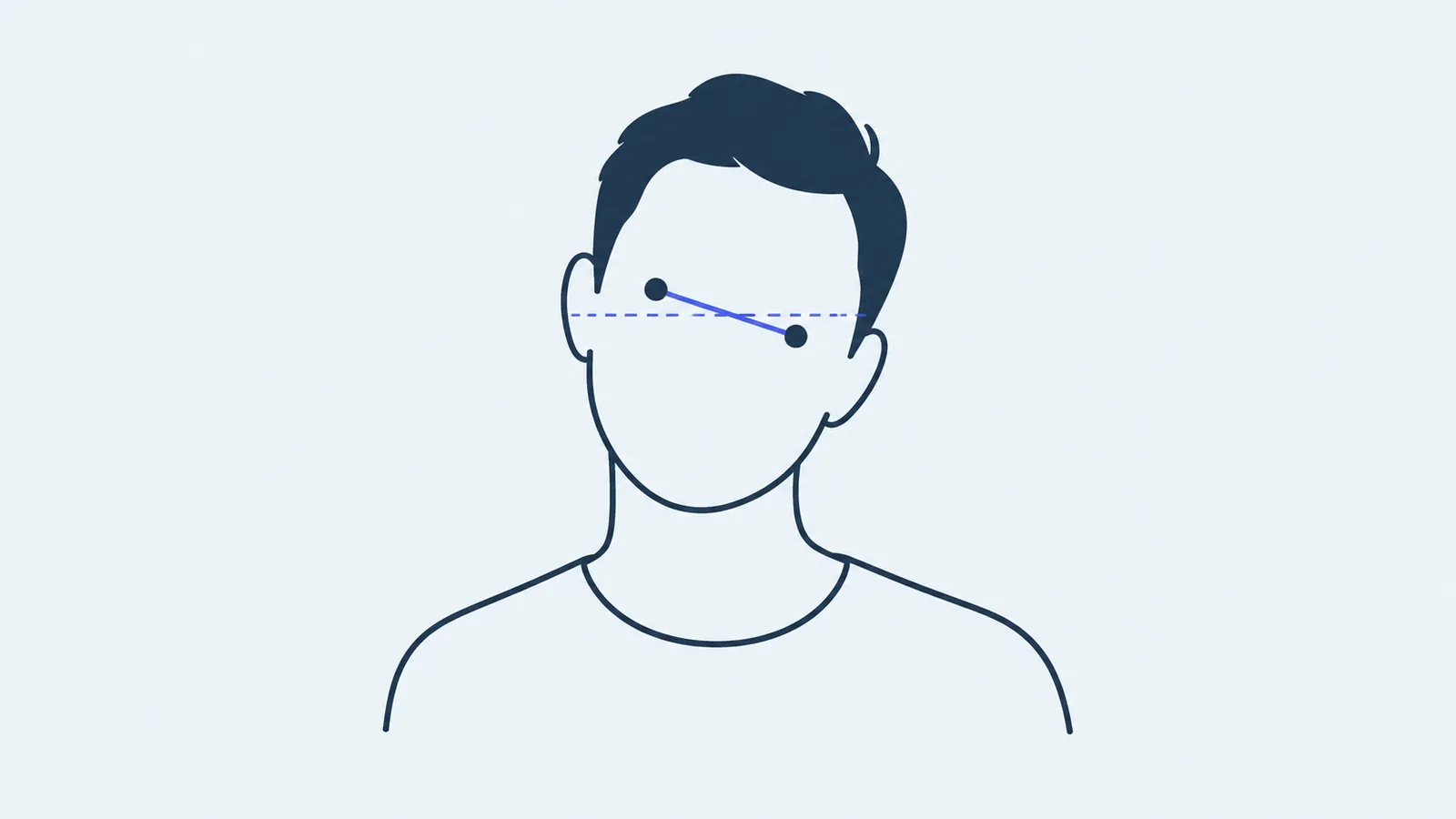
Head tilt posture is a sideways lean of the head, seen from the front as an eye or ear line that is not level. In photos the camera can fake it: a phone rolled slightly or a glance at the screen produces the same slope, and a flipped selfie reverses its direction. In two photo studies, examiners agreed less well on head tilt than on most front-view measures, so check the photo before you read any tilt angle, PoseAlign's included.
What is head tilt posture?
Head tilt posture is a lean of the head to one side, with one ear closer to its shoulder than the other. It happens in the frontal plane, the plane you see when you face someone, so it shows up in a front photo. It is easy to confuse with two other head positions:
- Head rotation: the head turns left or right, as when you look over your shoulder. One ear becomes hidden in a front photo.
- Forward head position: the head sits in front of the shoulders. You see it from the side; our article on the forward head angle in a side photo covers it.
Small tilts are common in people without complaints. In a 1989 study of healthy dental students by Huggare (Acta Odontologica Scandinavica; 22 on X-rays, 46 on photos, each recorded twice a week apart), frontal head position varied within about 5° either side of vertical. That range describes one study's group and is not a cut-off for normal.
Why does my head look tilted in pictures?
Often because the photo, not your posture, adds the tilt, or because the mirror you usually check hides it. The common reasons:
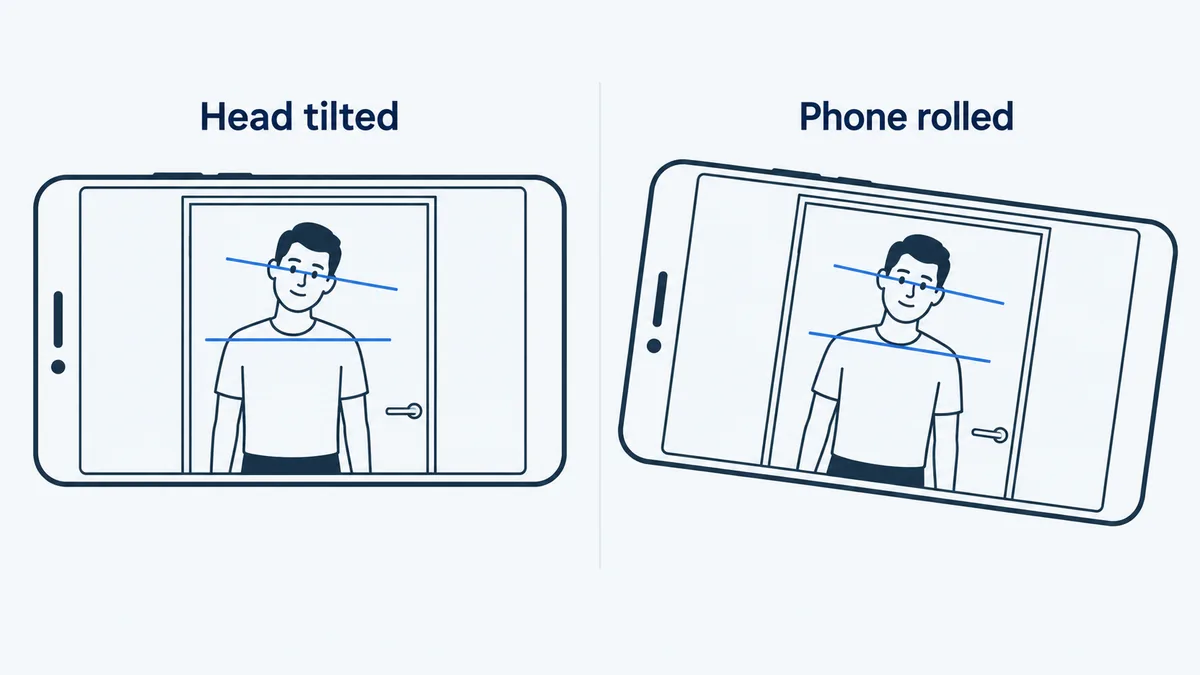
- The phone is rolled. Any roll of the camera adds the same slope to every line in the picture. If your eye line, shoulders, hips and a door frame behind you all slope the same way, the phone is the cause.
- The mirror straightens you. In the Huggare study, people tended to correct a tilted head spontaneously when they looked in a mirror, and the author advised against a mirror when recording natural head position. So a head that looks level in the mirror can lean in a photo taken while you are not watching yourself.
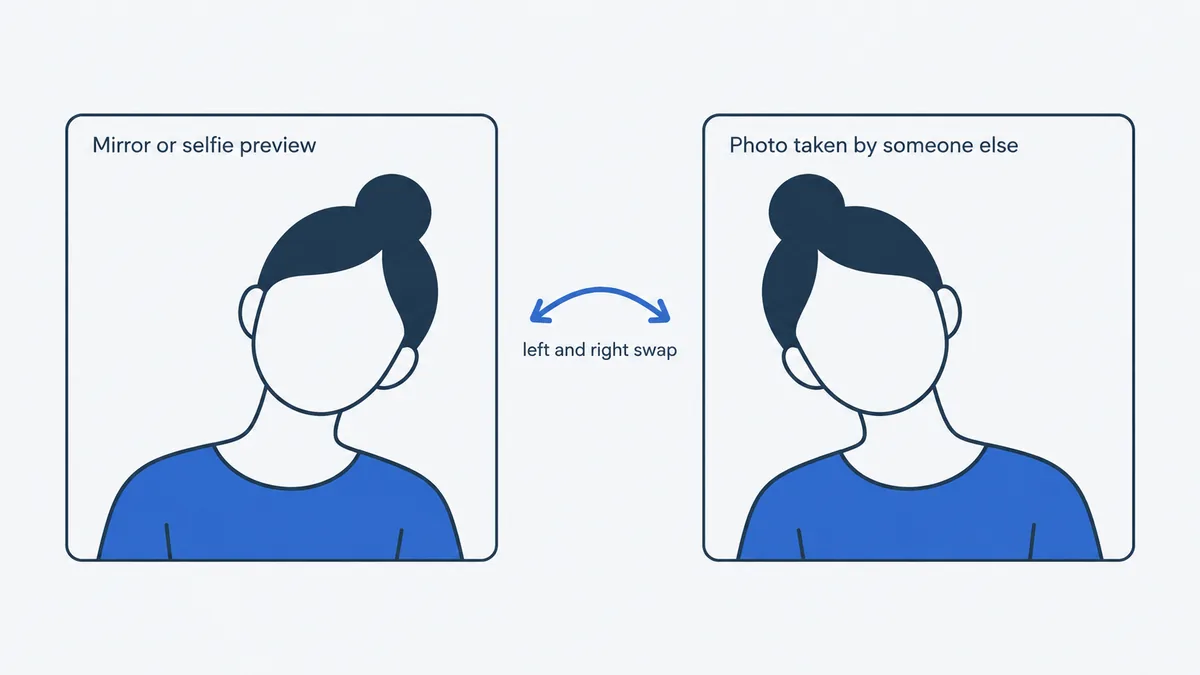
- Selfies are mirrored, or not. A mirror and a front-camera preview show you reversed. A photo taken by someone else is not, so a lean toward your right shoulder appears on the other side of the picture from where you see it in the mirror. Some phones also save selfies flipped back by default; on Samsung Galaxy phones a "Save selfies as previewed" setting decides which version you get, as SamMobile explains. Two selfies can therefore show the same tilt in opposite directions.
- You are looking at the screen. To see yourself in the preview, you tip your head toward it, and the camera records that.
How is head tilt measured in posture research?
Research measures head tilt as the angle between a line across the head and a true horizontal or vertical. The line usually runs through both pupils, both eyebrows or both ears, and a plumb line hung in the picture supplies the true vertical. A 2015 study of 126 dental students in Brazil shows a typical setup (Faulin et al., 2015, Brazilian Oral Research):
- the camera stood on a tripod at 1.50 m height, 1.50 m from the platform where participants stood;
- a plumb line with markers hung in the picture to calibrate the vertical;
- in the posture software SAPO, the examiner drew the line between the two pupils and measured its angle to the true vertical;
- each photo was measured three times and the mean was used.
Head tilt is one of the harder front-view measures to repeat between examiners. The intraclass correlation coefficient (ICC) used below is a reliability statistic where 1 means perfect agreement.
- In the validation study of the SAPO software, five physical therapists marked the same photos. For the head's horizontal alignment, agreement between raters was an ICC of 0.68, which the authors classed as not acceptable, and they noted that this measure depended on the plumb line calibration (Ferreira et al., 2010).
- In a 2022 study of the APECS app in 100 healthy young adults with skin markers placed by clinicians, head alignment from the front had an inter-rater ICC of 0.51, and the authors concluded that head alignment was reliable only in the side view (Trovato et al., 2022).
For you, this means a difference of a degree or two between two photos says little on its own, even before the camera is taken into account.
How a front photo estimates head tilt without markers
A photo app without skin markers works from the points its pose model detects on the face. It can draw a line between the left and right eye points or ear points and measure how far that line slopes in the image. Google's MediaPipe Pose Landmarker is a publicly documented example: among its 33 body points are inner, centre and outer points for each eye, a point for each ear and the two corners of the mouth. These are estimated positions on the image, not landmarks found by touch.
PoseAlign reports head tilt in degrees as the first row of its front-view table; in the latest example on the site it reads 2.9°. PoseAlign does not publish which points it uses for head tilt, how it calculates the value or the rule that highlights a value, so read the number on the app's own scale and do not compare it with angles from the studies above or from other apps.
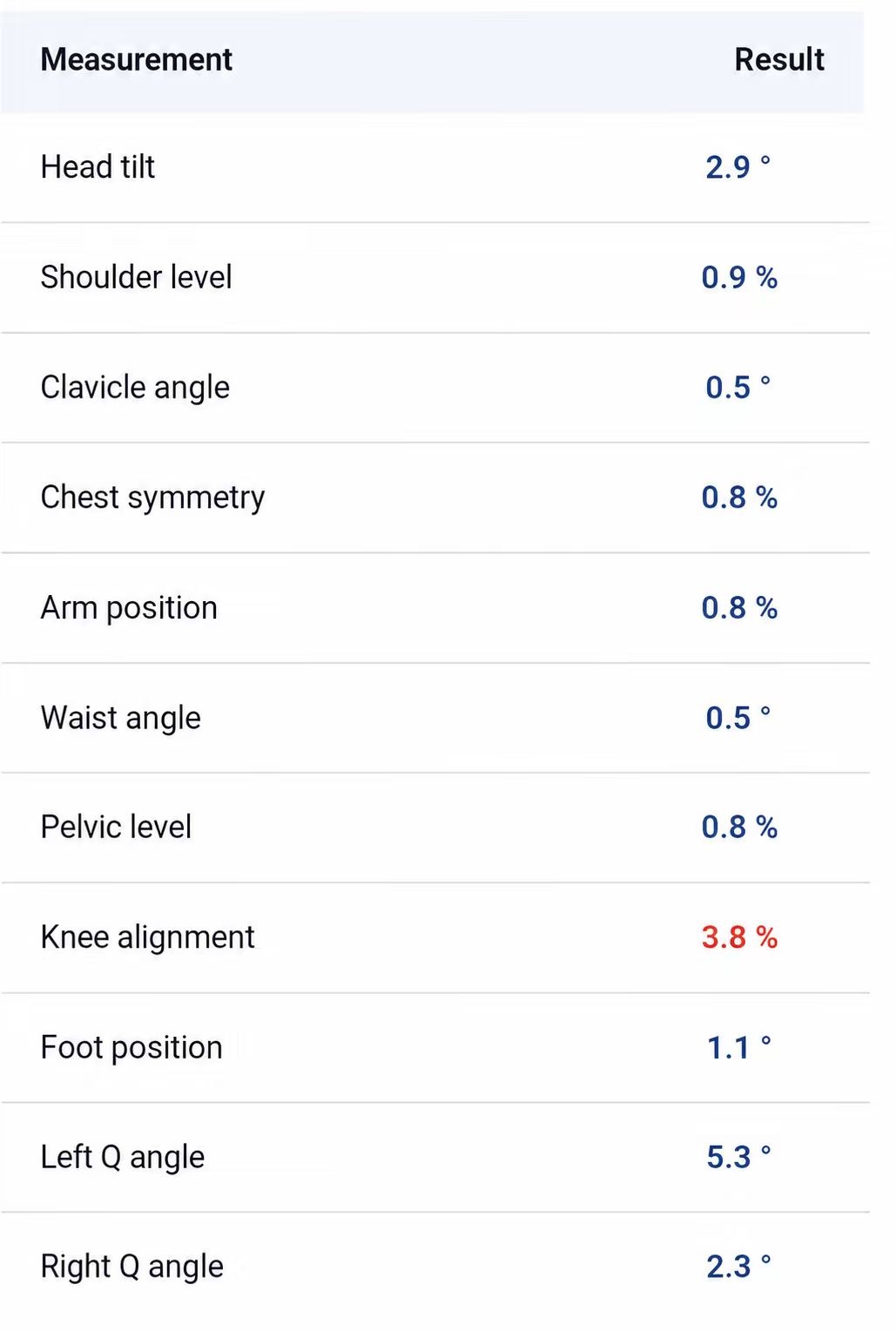
The front-view posture analysis page lists all 11 front-view measurements from the same example.
Which photo errors can create a head tilt?
Besides a rolled phone and a glance at the screen, a turned head or hidden face points can move the line. The research setups above used a plumb line for a true reference; at home, a level phone on a stand and a fixed point to look at are the closest equivalents.
| Error | What it does | Fix |
|---|---|---|
| Phone rolled to one side | The image's horizontal is no longer level, so a level head looks tilted. | Use a stand and the camera's grid or level guide. |
| Looking at the phone screen | You tip your head to see yourself. | Use the rear camera with a self-timer and look at a mark on the wall at eye level. |
| Head turned slightly | One ear hides and its point may move, which changes the line. | Face the camera squarely, nose pointing at the lens. |
| Hair over one ear | The ear point is guessed and can shift. | Tie long hair back and keep both ears visible. |
| Glasses, a hat or a hood | Frames, glare or a brim can make eye and ear points harder to place. | Take off the hat or hood; remove glasses if you can stand safely without them. |
| Hand-held selfie | The raised arm and the phone angle change from shot to shot. | Use a stand and the self-timer. |
Our guide on how to take posture photos covers the full setup.
How is head tilt different from shoulder level?
Head tilt describes the head and shoulder level describes the shoulders, and either can slope while the other stays level. Your shoulders can be level while your head leans, for example when you rest your head to one side, and one shoulder can sit higher while you hold your head level, for example when you carry a bag on that side. A tilted camera moves both lines the same way.
In PoseAlign, head tilt is reported in degrees and shoulder level as a percentage, so the two numbers cannot be compared directly. Look at the landmark overlay to see which way each line slopes. Our article on uneven shoulders and shoulder level in photos explains the shoulder measurements.
How to check a head tilt result
Treat a single value as how your head sat in one picture, and look for a pattern across photos taken the same way:
- Open the report and check where the eye and ear points landed before you read the number.
- If a point sits on hair, a frame or a hood, retake the photo.
- Take three front photos with the same setup, stepping away and back between them.
- See whether the head leans the same way each time. If the direction changes, the difference is probably the pose or the camera.
- Compare later reports only when the camera height, distance and stance match.
Our guide to reading a posture analysis report explains the units and the other rows. PoseAlign is not a medical device and does not diagnose, treat or correct posture. A photo cannot tell you why your head tilts. If your head tilts persistently outside photos, discuss it with a healthcare professional. The American Association for Pediatric Ophthalmology and Strabismus notes that people with fourth nerve palsy, a weakness of the nerve to one eye muscle, sometimes tilt their head to ease double vision; this is one possible cause, not a diagnosis from a photo.
The NHS advises getting double vision checked, even if it comes and goes. Seek urgent medical help if it starts suddenly or comes with eye pain. Double vision after a head injury, or blurred or double vision with a severe headache or enlarged pupil, needs emergency care. In a baby, a head that keeps tilting to one side can be a sign of torticollis (wry neck), and Ireland's HSE advises asking a GP or public health nurse for an urgent appointment. If you have neck pain or stiffness that does not go away after a few weeks, or other symptoms such as pins and needles or a cold arm, the NHS neck pain page advises seeing a GP.