
BLOG
Uneven hips test: why a small difference is common and what a photo cannot tell you
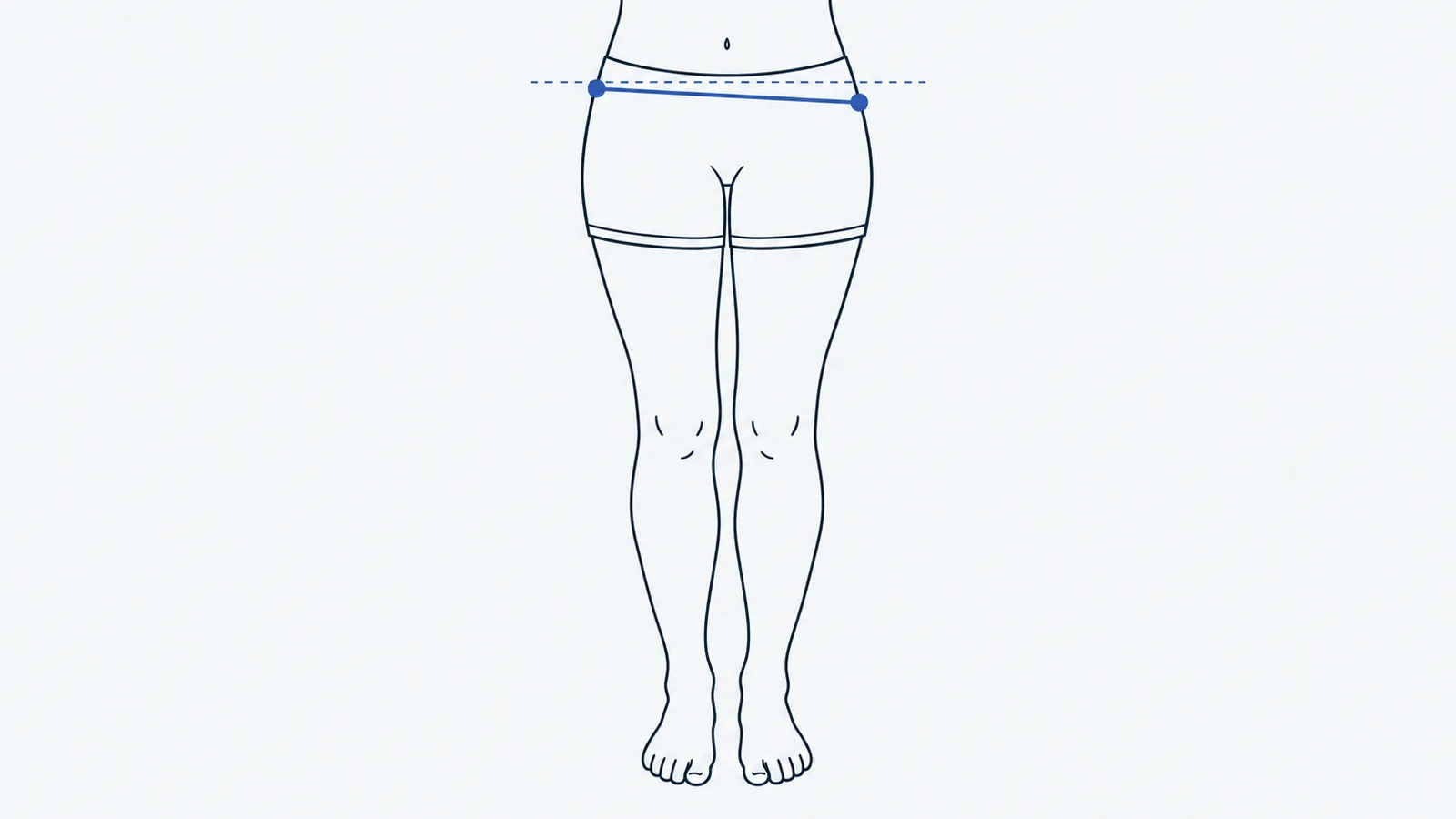
A small difference in hip height is common, so one hip sitting slightly higher in a front photo is not on its own a sign of a problem: in standing X-rays of 134 adults referred for non-orthopaedic problems, the median sideways tilt of the pelvis was 2.0°. A photo can show whether one hip point sits higher in the stance you took. It cannot tell you why, and it cannot tell you whether one leg is shorter.
How much hip difference is common
The medical term for uneven hips is pelvic obliquity: the pelvis tilts sideways so one side sits higher. A 2023 study in the Journal of Experimental Orthopaedics notes there is no gold standard for measuring it (Moharrami et al., 2023). The authors measured it on standing X-rays as the angle between the horizontal and a line joining two points near the hip sockets. In their 134 patients at a hospital in Tehran, Iran, referred for non-orthopaedic problems and screened for normal gait and posture:
- the median tilt was 2.0°, and half of the group fell between 0.9° and 3.1°;
- 95% of the group had a tilt of 5.6° or less;
- the tilt did not differ between men and women or change with age.
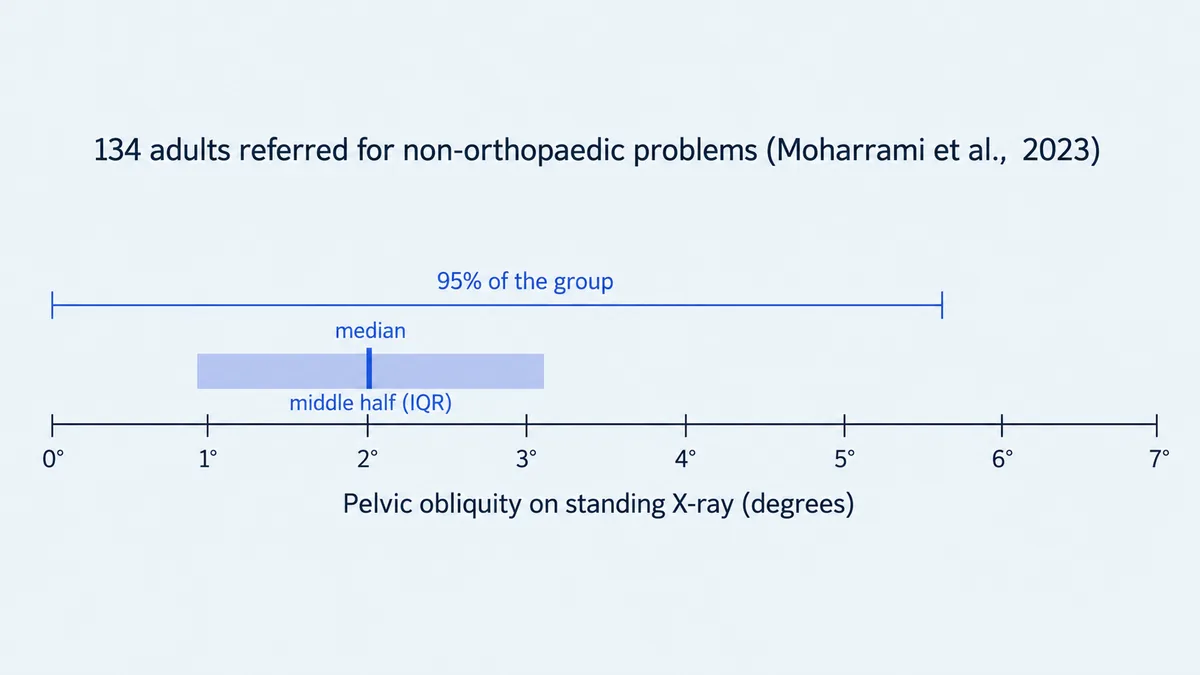
The authors concluded that slight pelvic obliquity may be normal and should not automatically be blamed on pain, scoliosis or weak hip muscles. They note that the sample was small and that these were clinic patients rather than healthy volunteers, so the figures may not represent the whole population; the range is a description of this group, not a cut-off for your own photo. The median also differed significantly from zero, so in this group a perfectly level pelvis was not the usual finding.
Do uneven hips mean one leg is shorter?
A photo cannot answer this, and neither can the pelvis on its own. A 2005 review of leg-length inequality in the journal Chiropractic & Osteopathy pooled X-ray studies of 573 people: about 90% had some difference in leg length, with an average of 5.2 mm, and the author concluded that a difference of this average size is not likely to be clinically significant (Knutson, 2005). The same review notes that several authors call it a mistake to deduce the side and amount of a leg-length difference from uneven pelvic crests.
Clinical tools show the same gap. The Palpation Meter, a caliper with a built-in inclinometer placed on the iliac crests (the upper rims of the pelvis), was tested in 30 people (15 healthy, 15 with a suspected leg-length difference) against standing X-rays (Petrone et al., 2003). It measured the crest height difference well (ICC 0.90 and 0.92 for two raters) but was less accurate as an indirect estimate of leg length (0.76 and 0.78). Our reading: if an instrument placed on the bone is less accurate for leg length, a photo of the outside of the body is not a way to measure it either.
What a photo app measures instead
Clinicians compare bony points they find by touch: the iliac crests, or the ASIS, the bony points at the front of the hips. In the SAPO posture software study of photos of 22 people, markers on the two ASIS gave very good agreement between five raters (ICC 0.84) (Ferreira et al., 2010). A phone app has no markers. Google's MediaPipe Pose Landmarker, a public pose model, estimates one "hip" point per side and has no point for the iliac crest or the ASIS. An app built on points like these compares estimated hip positions, not the crests or the ASIS a clinician feels.
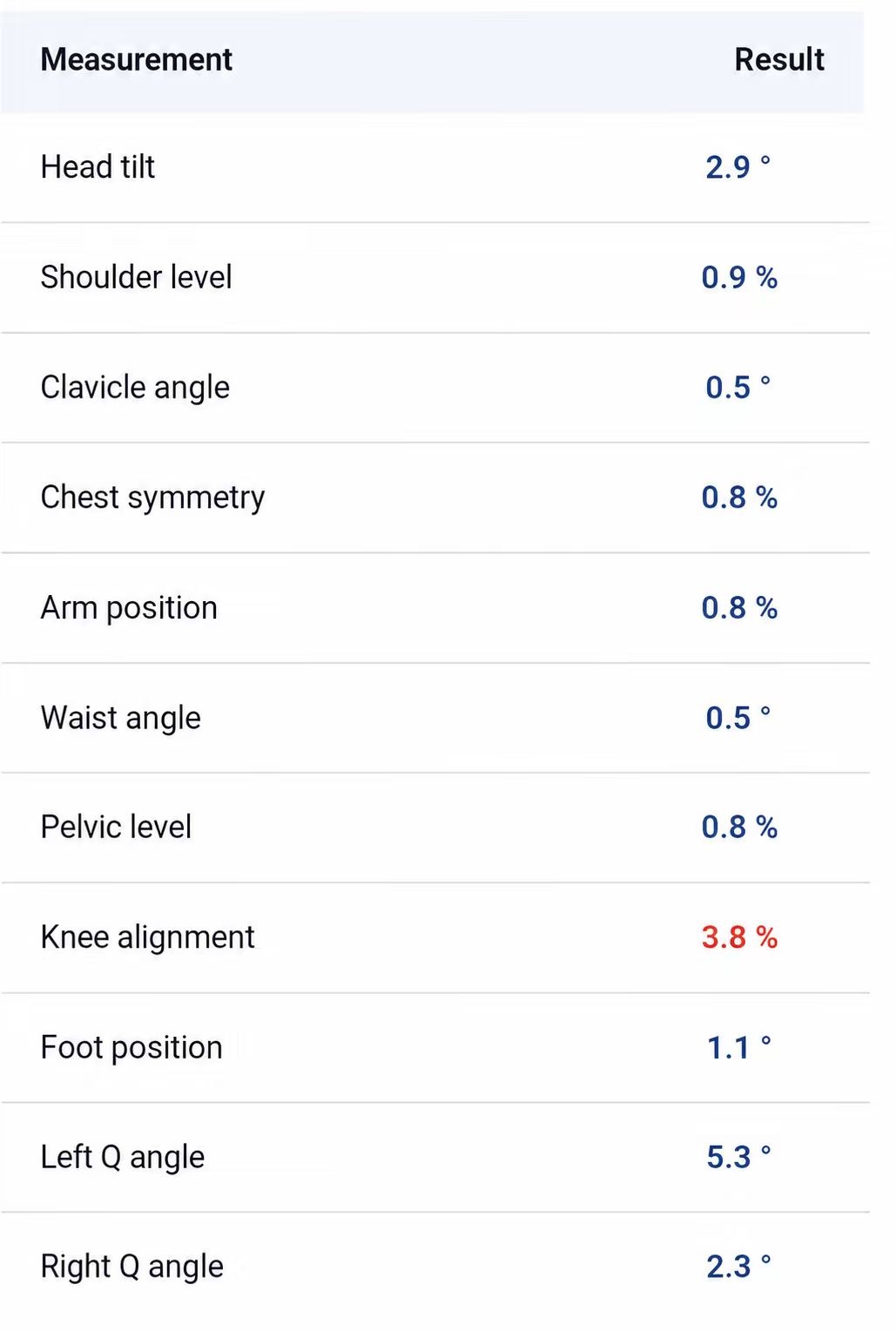
PoseAlign, a free Android posture analysis app, reports this as pelvic level, a percentage, next to waist angle in degrees, in the waist and pelvis group of its front-view analysis. The latest example on the site shows pelvic level 0.8% and waist angle 0.5°. PoseAlign does not publish either formula, so the percentage cannot be turned into degrees or compared with the 2.0° median above. The example values are not targets.
Stance details that drop one hip
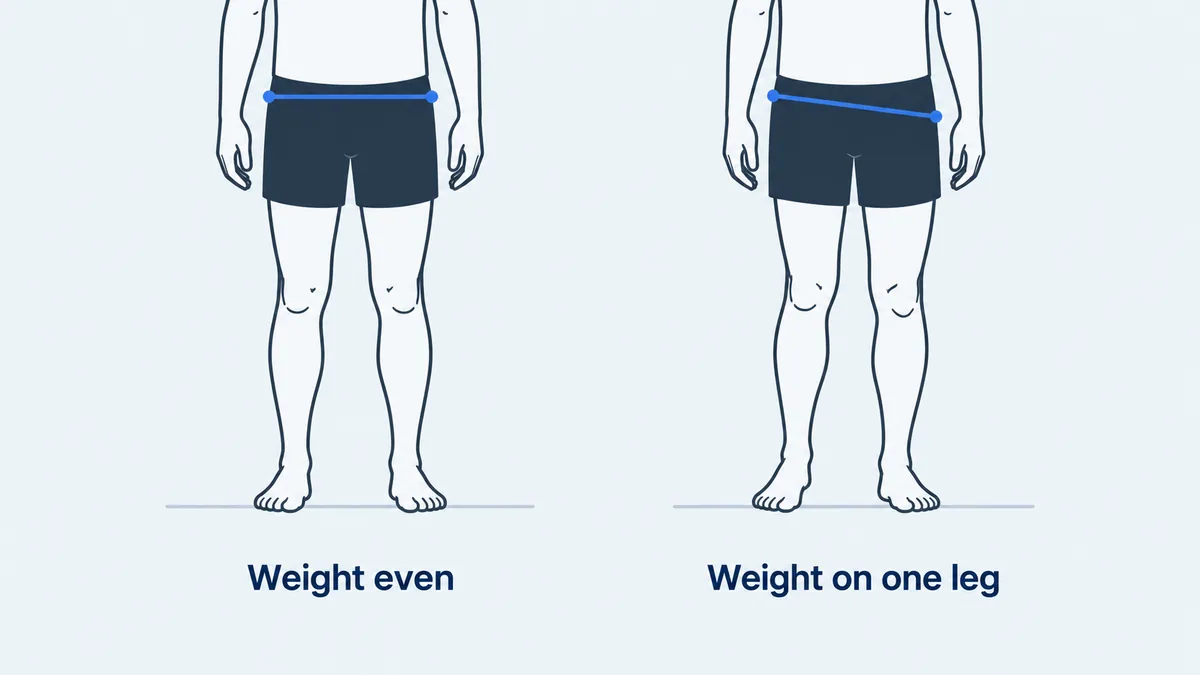
Several stance details can lower one hip in a photo. These are the ones to control:
| Cause | What it does | Fix |
|---|---|---|
| Weight shifted onto one leg | The pelvis drops on the side of the relaxed leg. | Stand with weight on both feet, feet hip-width apart. |
| One knee softer than the other | That side of the pelvis lowers. | Straighten both knees comfortably, without locking them. |
| Uneven floor, or one shoe on | One leg stands higher. | Stand barefoot on a flat floor. |
| Belt, crooked waistband or loose shorts | The outline around the hip changes, and the detected point can follow the fabric. | Wear fitted shorts or leggings with the waistband straight, no belt. |
| Hand on a hip | The arm covers or pulls the hip point. | Use the self-timer, arms hanging relaxed. |
Camera errors (a tilted phone, a camera off to one side) move the hip line the same way they move the shoulder line; the table in one shoulder higher in photos covers them.
What to do with your result
Take two or three front photos with your weight even, barefoot, in fitted shorts. Our reading: if one hip is higher in some photos and not others, the stance is the likely cause. If the same hip is higher every time, treat that as a description of how you stood, not a diagnosis. The NHS lists one hip sticking out among the signs of scoliosis, which most often starts in children aged 10 to 15, and advises seeing a GP if you think you or your child has it. See a GP or physiotherapist too if uneven hips come with back or hip pain or a limp. They can examine you and, if needed, measure leg length or a spinal curve on an X-ray. PoseAlign is not a medical device and does not diagnose or treat any condition.
The front photo shows only the sideways tilt. The forward or backward tilt of the pelvis needs a side photo; see pelvic tilt from a photo. How pelvic level fits with the other rows of the report is in how to read a posture analysis report.