
BLOG
Knock knees or bow legs: what a front photo can and cannot show
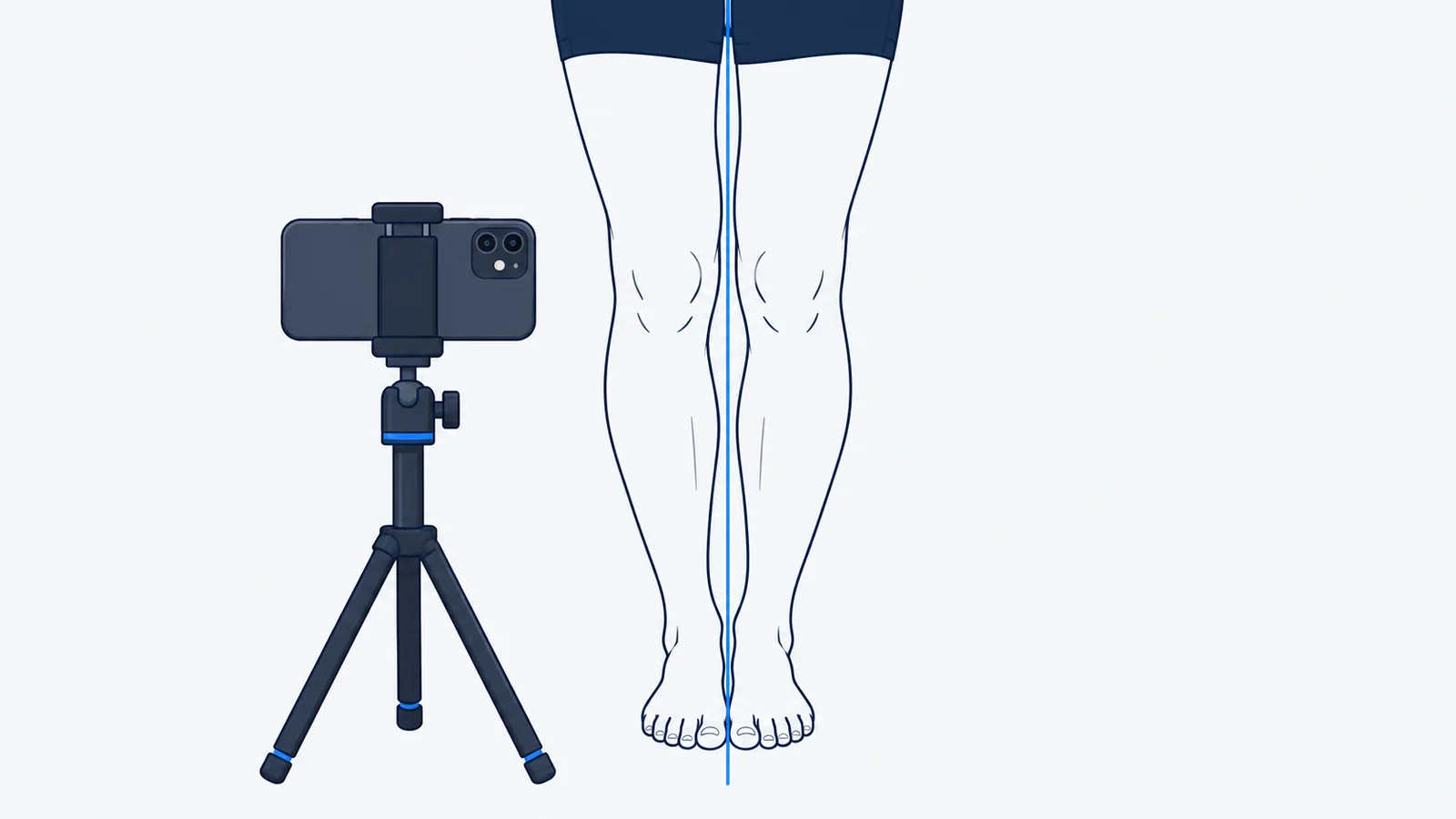
To check for bow legs or knock knees, stand with your feet and ankles together and look at your knees: if the knees stay apart, that is the pattern children's hospitals describe as bow legs; if the knees touch while the ankles stay apart, the pattern they describe as knock knees. A front photo with the kneecaps facing forward records it, as one children's hospital suggests to parents, but cannot tell you whether the shape needs treatment.
The ankles-together self-check
Children's hospital pages describe the same check. In bow legs, when the feet and ankles are together, the knees stay apart; in knock knees, when the knees are together, the feet and ankles stay apart (Royal Children's Hospital Melbourne; Cleveland Clinic describes the bow-legs half). These are descriptions of a shape, not a pass or fail test: none of these pages gives a gap size that counts as abnormal. Boston Children's Hospital adds that bowing is usually obvious when the legs are straight and the toes point forward (Boston Children's).
- Stand barefoot in shorts, legs straight but not forced back, toes and kneecaps pointing forward.
- Bring your feet together until either your ankles or your knees touch.
- If your ankles touch first, look at the gap between your knees. If your knees touch first, look at the gap between your ankles.
- Note which gap you see and roughly how wide it is.
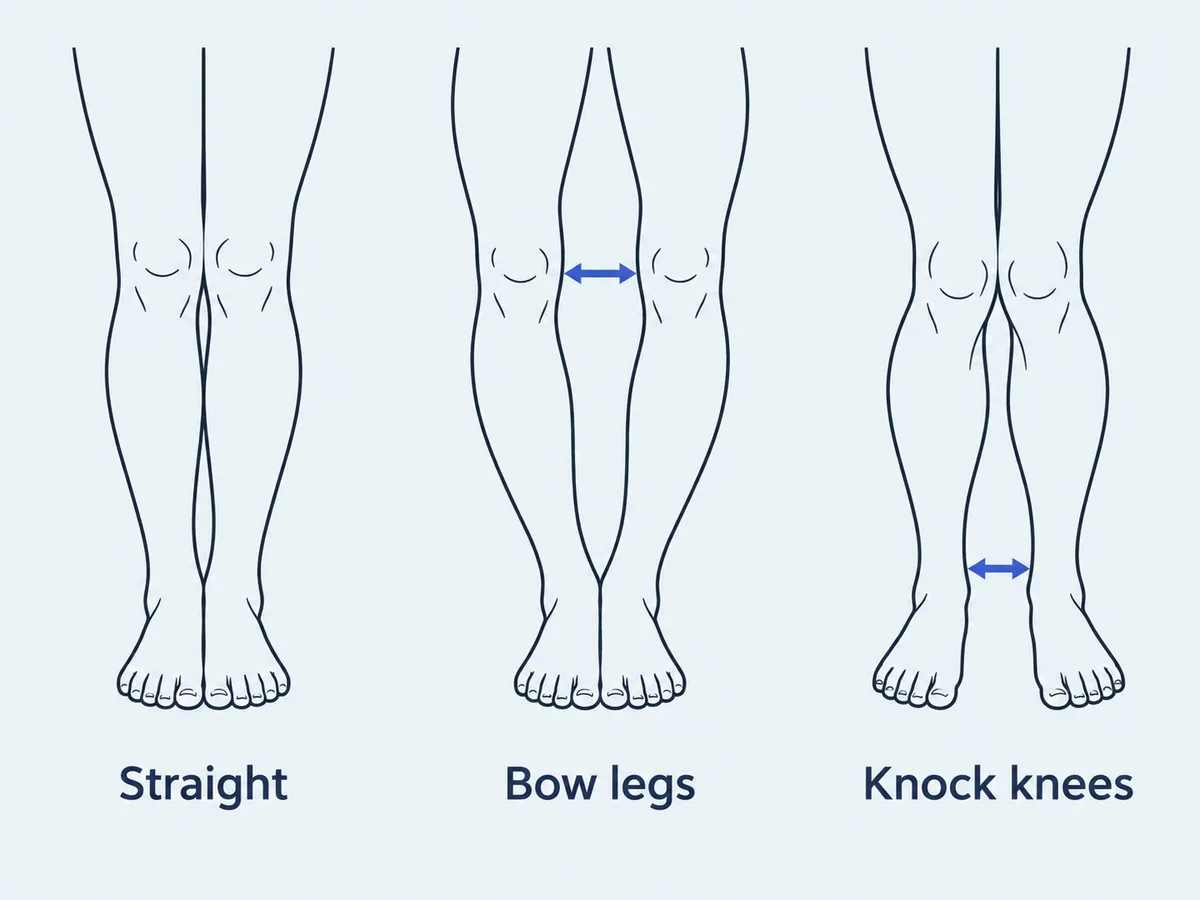
Two things change the result. Turning the feet in or out rotates the legs and changes how the knees line up from the front; Memmel et al. (2023) cite earlier photo research that named leg rotation among the factors with the most influence on the measured angle. The same paper notes that the knee or ankle gap measurement is limited by the soft tissue around the knee, so the gap you see is not the same as the alignment of the bones.
How to photograph it
The Royal Children's Hospital in Melbourne suggests that parents who are concerned about the shape of a child's legs take a photo every six months to show the doctor, with the child standing and the knees facing forward. The same approach works for an adult who wants a record. Research setups for leg photos put the camera on a tripod at knee height, about 3 m away (Sacco et al., 2007; Memmel et al., 2023); Memmel et al. chose knee height to reduce parallax error.
- Phone level, at knee height, centred on your legs.
- Fitted shorts or underwear, so the knee outline is visible.
- Two photos: one standing normally with feet hip-width apart, and one in the ankles-together position above.
- Same place and distance each time, so later photos can be compared.
Full-body setup is covered in how to take posture photos.
Is it normal to be slightly bow-legged?
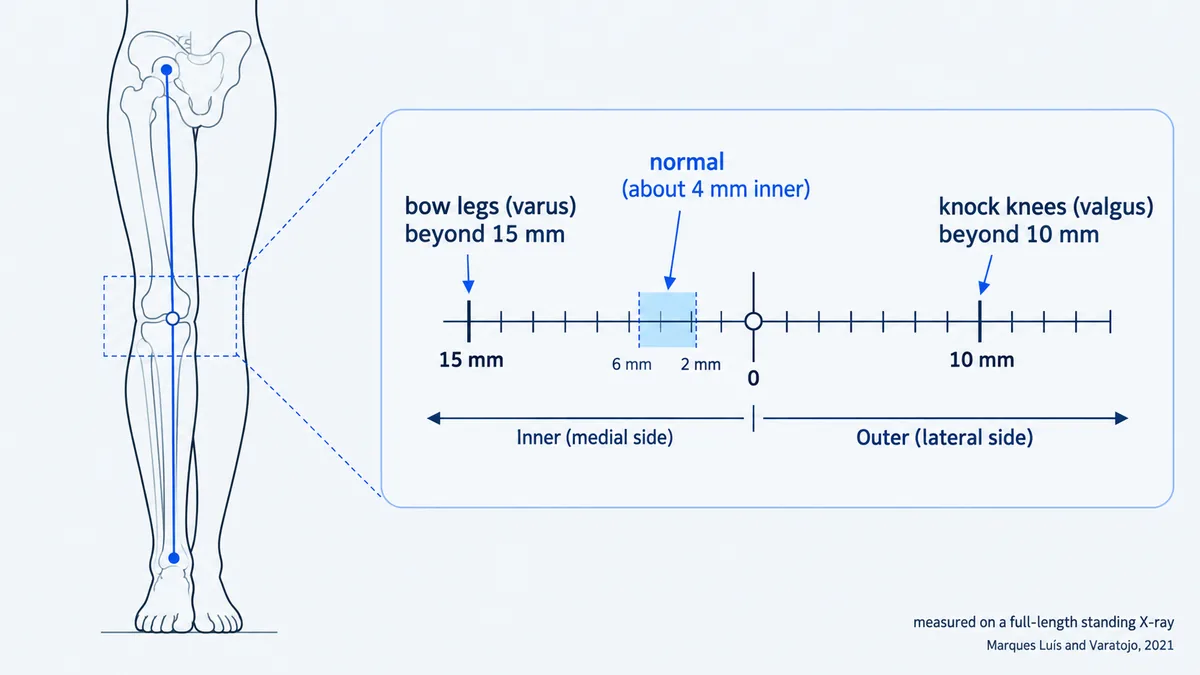
On X-ray, the normal adult leg already sits slightly toward the bow-legged side. Doctors judge leg alignment on a full-length standing X-ray by where the mechanical axis, a line from the centre of the hip to the centre of the ankle, passes the knee. A 2021 review in EFORT Open Reviews gives the normal position as about 4 mm (±2 mm) toward the inner side of the knee centre, and treats a line more than 15 mm toward the inner side (bow legs, varus) or more than 10 mm toward the outer side (knock knees, valgus) as a clinically significant deviation (Marques Luís and Varatojo, 2021). The review notes that these limits come from population statistics. Millimetre offsets at the knee are not something a home photo can measure.
In children, leg shape changes with age, and the hospital pages agree on the pattern while differing by about a year on the ages. Bow legs are normal in babies and toddlers and usually straighten by about age 2 (Boston Children's, Cleveland Clinic) or 2 to 3 (Royal Children's Hospital); knock knees are common between about 3 and 5; and the legs are usually in a normal position by about age 8 (Royal Children's Hospital). The same hospital advises against special shoes, braces or exercises for this normal pattern. Cleveland Clinic notes that bow legs that never straighten can last into adulthood, usually without pain, and are a concern if they cause pain or discomfort.
What careful photo studies could measure
Research shows how far a well-controlled photo can go, and what it takes:
- Stickers over the hip bones. In 50 adults recruited from the community, Sheehy and colleagues placed stickers over the ASIS, the bony points at the front of the hips, and took a photo and an X-ray in the same standardised stance (Sheehy et al., 2015). The photo angle correlated highly with the X-ray (r = 0.92) but read 4.5° more toward bow legs on average, and the authors judged that a change of about 3° between two photos would count as a true difference.
- Ultrasound to find the hip joint. In 18 adults (34 legs, mean age 50) who had recently had a full-leg X-ray, Memmel and colleagues located the centre of each hip joint with ultrasound and marked the knee joint line, found by touch, with an elastic band before the photo. With a body mass index under 30, photo and X-ray differed by 2.4° on average; at 30 or above, by 5.5°. The authors concluded the method could not replace a full-leg X-ray when planning surgery.
A phone app does neither. Public pose models such as Google's MediaPipe Pose Landmarker estimate hip, knee and ankle points from the image, which are not the hip joint centre that the ultrasound study located.
Where PoseAlign's knee alignment row fits
PoseAlign, a free Android posture analysis app, reports knee alignment as a percentage in its front-view table. In the latest example on the site it reads 3.8% and is the only row shown in red; the earlier PDF export from September 15, 2026 shows the same 3.8% in red. PoseAlign states that a highlighted value is not a diagnosis, and it does not publish the formula, the highlight rule, or whether the percentage points toward bow legs or knock knees. So the row cannot tell you which way your legs angle, or whether the shape is within the normal range. Use the landmark overlay and your own ankles-together photo to see the shape, and use the row only to compare your own reports taken the same way. The example values are not targets.
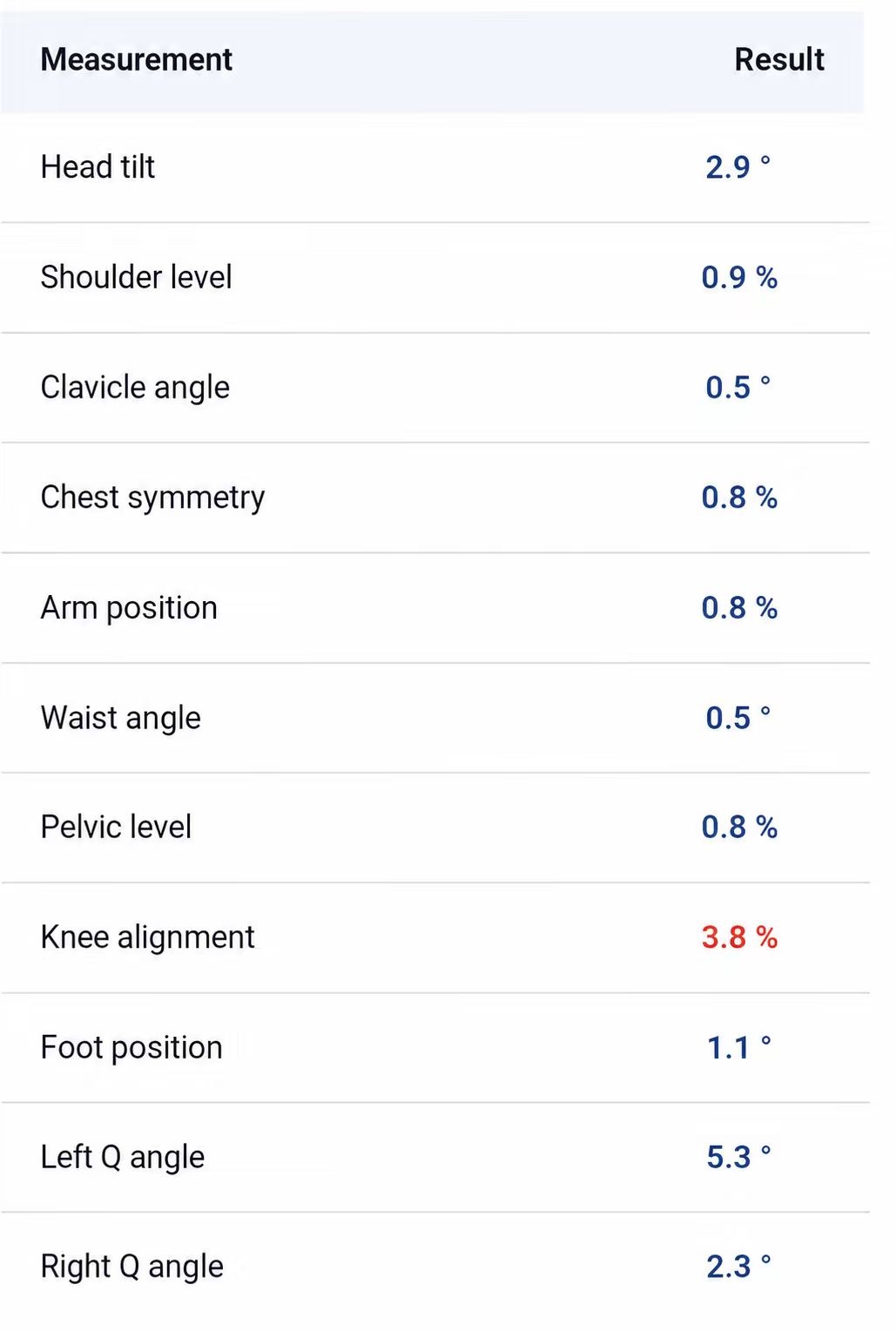
The Q angle rows in the same table measure something different, the angle at each kneecap; see Q angle measurement. How all 13 rows fit together is in how to read a posture analysis report.
When to see a doctor
For a child, the Royal Children's Hospital advises seeing a doctor if the bow legs or knock knees are severe, bow legs last beyond age 3, knock knees get worse after age 8, only one leg is affected, the child has pain or a limp, or the child is unusually short for their age. Boston Children's gives a similar list and uses an earlier age for bowing: bowing that gets worse after age 2. Bring the six-monthly photos. For an adult, Cleveland Clinic advises talking to a doctor if bow legs cause pain or discomfort; for knee pain in general, the NHS advises seeing a GP if it does not improve within a few weeks, and getting urgent advice if the knee is very painful, cannot take weight, is badly swollen or has changed shape, or locks or gives way. A clinician will examine the legs and, where needed, order an X-ray. PoseAlign is not a medical device and does not diagnose, treat or correct leg alignment.